In November 2024, Dinners With Friends was a revived idea and a napkin sketch. By the start of September 2026, it had welcomed more than 500 guests across 50 dinners. Dates were routinely selling out six to eight weeks ahead, and nearly all of the remaining 2026 calendar was booked.
Pamela Silkstone first ran the concept twenty years earlier: put people who have never met around one table, give them a host, and make the first conversation easier. I took the relaunch from idea to first version, first paying customers and a business with more demand than seats. Along the way I built the brand, website, booking system, internal tools, mobile app and the search programme that now brings new people in.
The search programme delivered 5,530 Google clicks in June–August 2026, up 66.1% on the previous three months, alongside 381,345 search impressions. Building and maintaining a library of local guides gave the business a way to be discovered by people looking for food, activities and places to meet across Exeter and Devon.
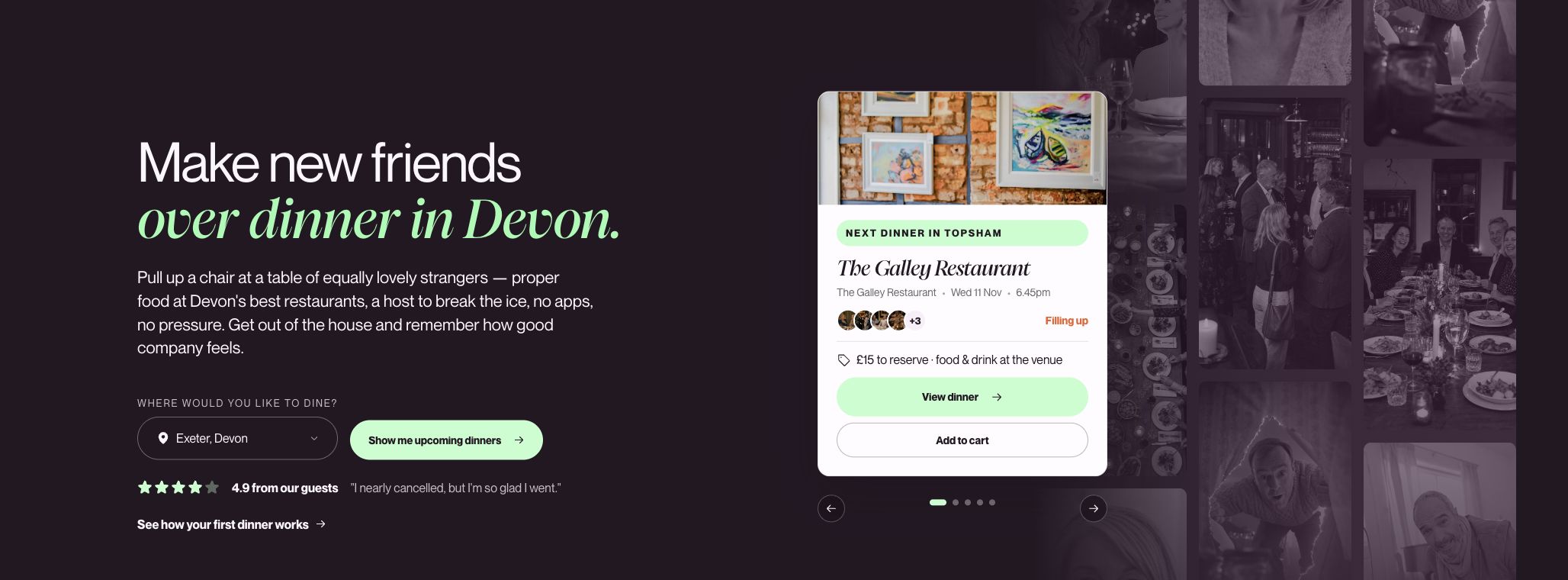
The live product now gives somebody the full answer before asking for a payment: what the dinner is, who it is for, where it happens, which dates still have room and what previous guests thought of it. They can move from the  Dinners With Friends website to a paid reservation without leaving the service.
Start with something Pamela could run
The first version existed before the custom application. I built it with Webflow and used Eventbrite for ticketing. The decision was practical: Pamela needed to edit pages, change the content, publish new dinners and manage the site without waiting for me.
That version got the idea into the world and brought in the first paying customers. It also proved the central bet: people would pay to sit at a table with strangers.
The trade-off became obvious as the business grew. The feature set was basic, the journey from the website into Eventbrite felt disjointed, and useful changes took longer than they should. Pamela could run the content, but I could not improve the product at the pace the dinners needed.
Replace the first build when speed became the constraint
In April 2025, I started a custom build with React and Next.js on the web, a Hono API and PostgreSQL underneath it. Within ten days, it had a new landing experience, live event data, Eventbrite checkout, analytics, advertising attribution and a waiting list. I kept the proven payment path while replacing the parts that were slowing the product down.
From there I could ship against what was happening at the dinners. Every event needed its own capacity, ticket state, guest list and messages. A sold-out date needed a waiting list. A cancellation needed a safe way to offer the seat again. In December 2025, I rebuilt the data model around event series and individual occurrences so one dinner concept could run across many dates without confusing the inventory.
Let demand write the roadmap
More than 500 people have now attended across 50 dinners in South West England. The common pattern is a full table six to eight weeks before the date, often with a waiting list behind it. That is a good commercial result, but it creates operational work: more dates, more payments, more guest changes and more chances to promise the same seat twice.
I brought the booking flow in-house in stages. Ticket tiers came first, followed by a cart, temporary seat holds, a credit ledger, Stripe webhooks, refunds and disputes. The current checkout uses Stripe's Payment Element and supports guest payment. Somebody can enter an email and pay; the account is created behind the transaction so the booking, attribution and follow-up still belong to one customer record.
The waiting list became a proper workflow. A guest joins against a specific date. When a place opens, the team can send a timed offer, see whether it was delivered, resend it or revoke it. The hold protects the inventory while the guest decides.
Build the operation behind the dinner
The customer side covers discovery, payment, reservations, reviews, referrals, notifications and an inbox. The internal side covers dinner setup, bulk date creation, ticket tiers, attendee search, transfers, check-in, waitlist offers and communications across inbox, push and email.
Events generate time-sensitive work. Venues change. Places reopen. Reminders become due. Hosts need answers before service. I built previews, scheduling, delivery records and audience rules into the messaging tools so the team can see what was sent and what happened next.
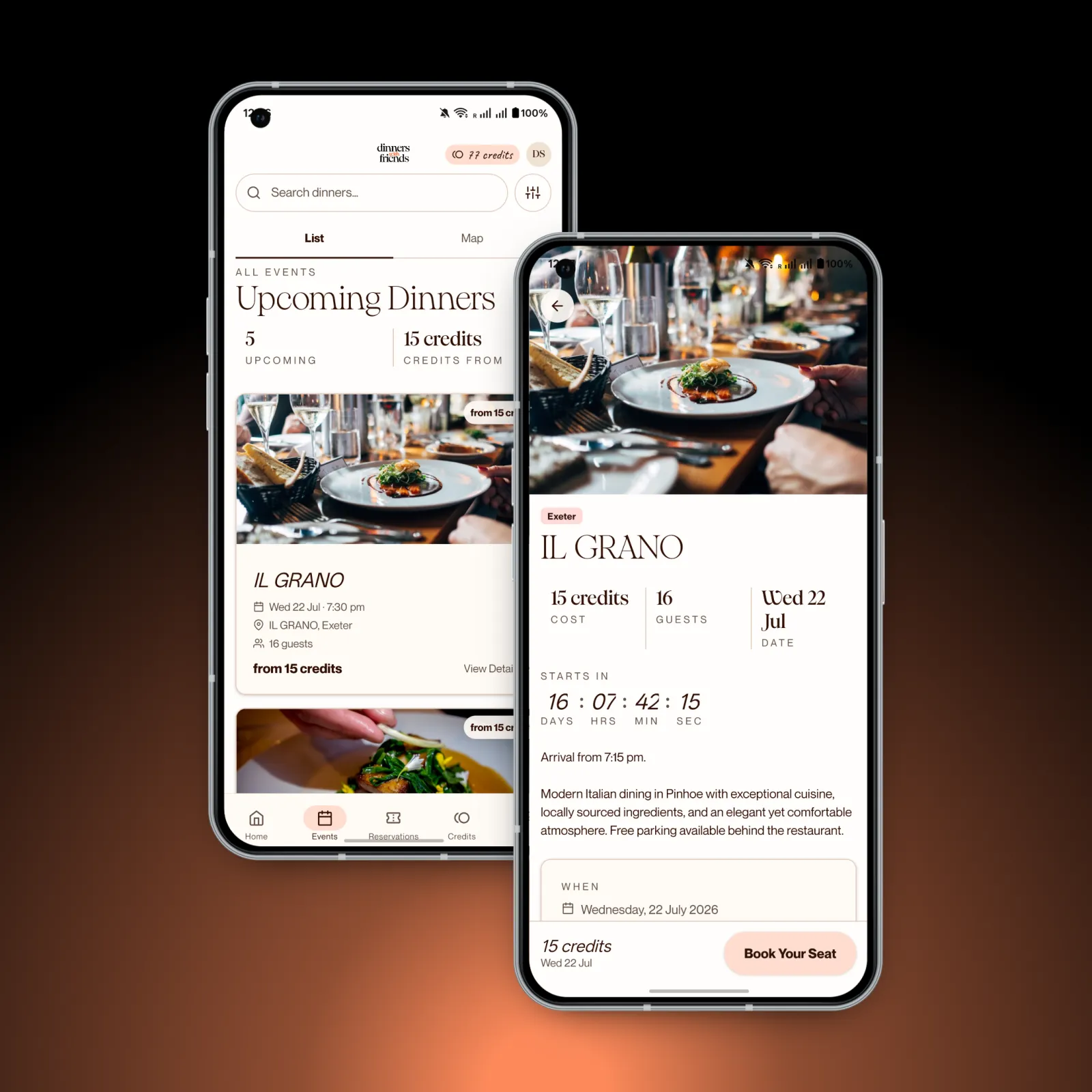
I also built an Expo app for the customer and host journeys. It covers event discovery, bookings, reservations, waitlists, credits, maps, conversation prompts, check-in and push notifications. Android reached an installable release build and the Play internal track. iOS reached launch preparation with runtime configuration, privacy metadata, review notes and store screenshots.
The visual system had to carry both the warmth of the dinners and the denser work of accounts, payments and administration. I took the brand through several iterations before settling on the current aubergine, cream and green system across the website, checkout, app and campaign work.
Move the live service without making customers start again
By July 2026, the original Supabase setup was getting in the way of how I wanted to run the product. I moved the live service to PostgreSQL, Better Auth, Redis and object storage on
Railway.
I rehearsed the migration against a fresh copy of the live data before cutting over. The production move preserved user IDs and password hashes, transferred stored media, kept the API contract stable and left every public URL in place. Existing customers kept their passwords. The local guides kept the addresses through which Google and readers already knew them.
That work was not a rebuild for its own sake. It gave me control over the data, authentication, jobs and storage without interrupting the people already using the service.
Grow Google search clicks by 66% in three months
I built the search work on the same principle as the booking product: publish something useful, measure what happens, then improve the part that is closest to working. The base included an MDX publication, page metadata, open-graph images, event and venue schema, breadcrumbs, internal links, sitemaps and IndexNow.
In April 2026, I turned that into a maintained local guide library. Seven leading guides received deep rewrites, followed by research and internal-link updates across another 115 articles. Search Console data became a work queue: keep dated snapshots, find pages within reach of page one, estimate the clicks lost to a weak title or description, then review the highest-value opportunity first.
Accuracy became part of the system too. The content inventory joins the articles on disk to the pages Google sees, counts named venues likely to go stale and weights that risk by search exposure. I added closed-venue registries, recurring-claim checks and primary-source review after audits found old businesses and poorly supported claims.
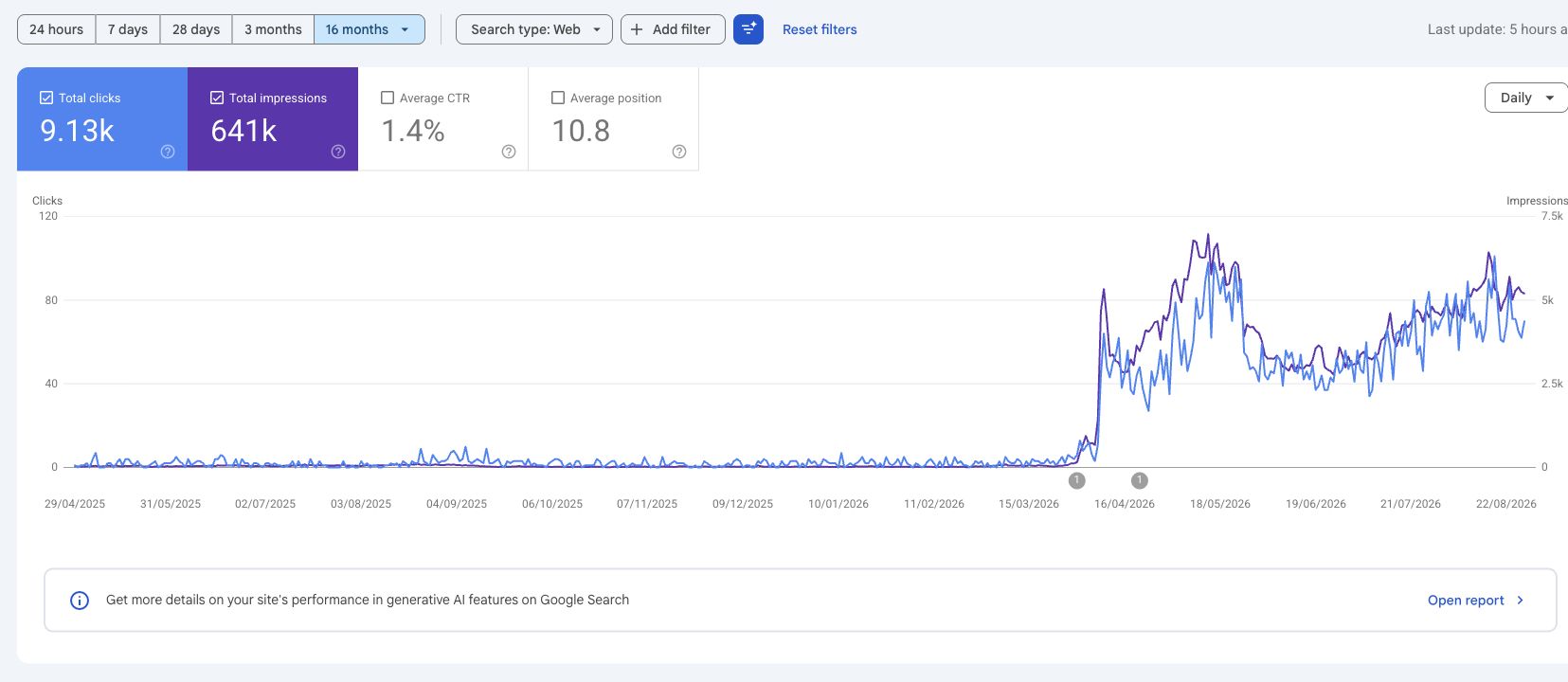
Search Console recorded 9,131 clicks and 640,956 impressions between 29 April 2025 and 28 August 2026, with a 1.4% click-through rate and an average position of 10.8. In Google's definition, these are appearances and clicks in search results. They are not bookings or revenue.
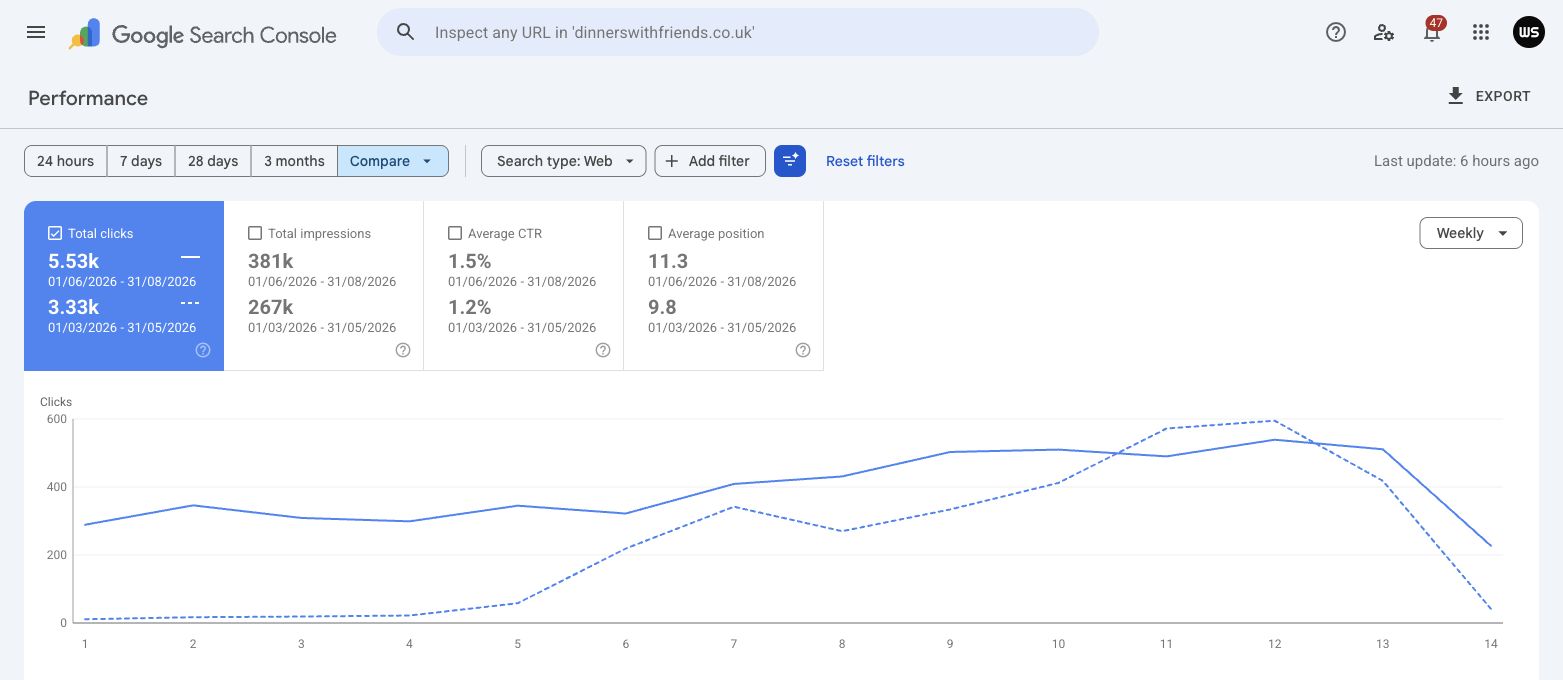
From June to August 2026, Google web search delivered 5,530 clicks, compared with 3,330 in March–May: 2,200 additional clicks, up 66.1%. Impressions rose from 266,718 to 381,345, up 43%. These are complete, consecutive 92-day periods, checked in Search Console on 6 September 2026. Average CTR rose from 1.2% to 1.5%, while average position moved from 9.8 to 11.3. This is a measured increase in search traffic; the comparison does not isolate seasonality or attribute dinner bookings to SEO.
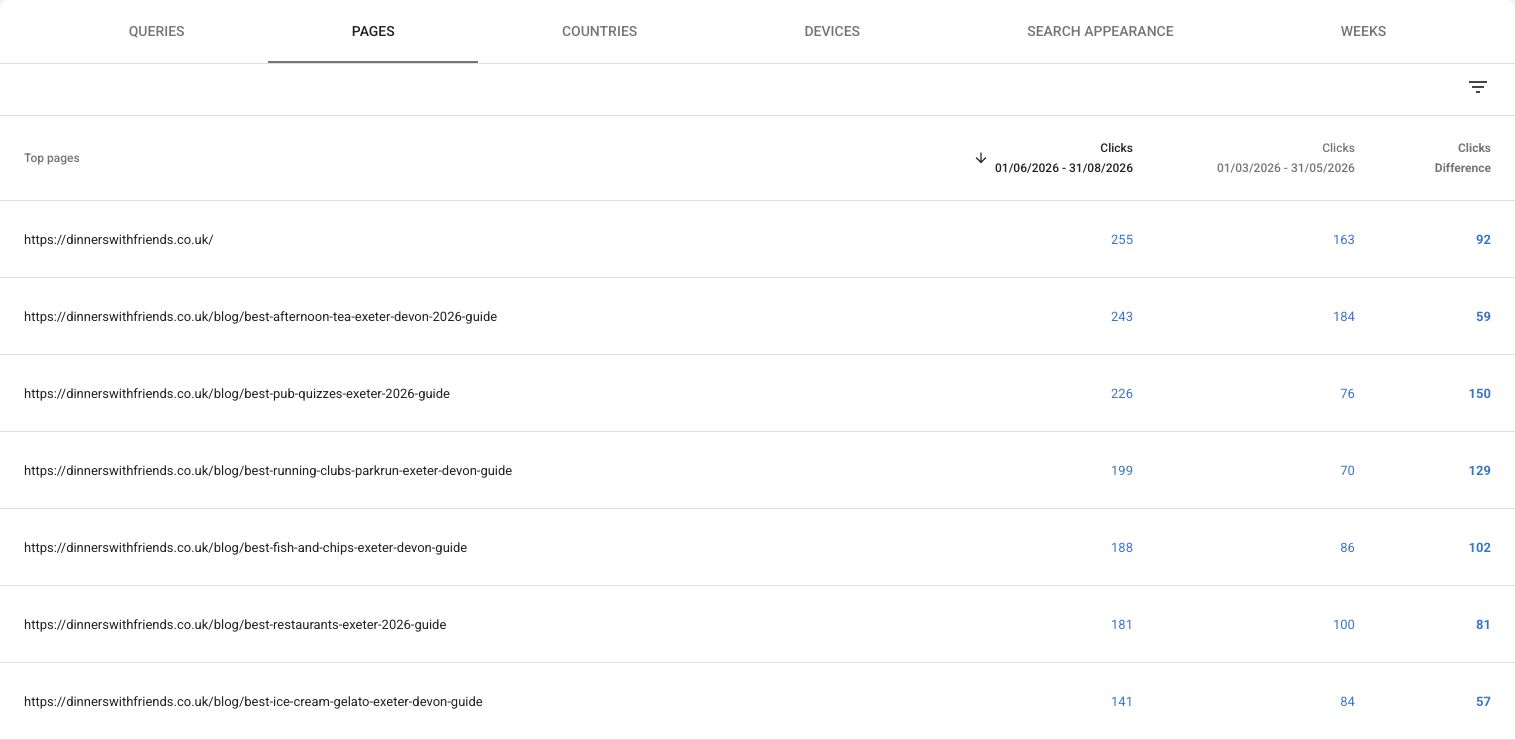
The landing-page table shows that the homepage led, followed by practical guides to afternoon tea, pub quizzes, restaurants, fish and chips, running clubs and ice cream. People find the site while making a local decision, get a useful answer, and meet the dinner product on the same visit.
The refreshed page report makes that editorial growth concrete. Between March–May and June–August 2026, the pub quiz guide grew from 76 to 226 clicks, the running clubs guide from 70 to 199, and the fish and chips guide from 86 to 188. Each of those guides more than doubled its Google clicks. This gives the business useful entry points beyond searches for its own name.
Track AI agents without calling them customers
I now measure AI discovery in three separate layers. A crawler fetch means an engine accessed a page. A citation means the page appeared as a source in an answer. A referred session means a person clicked through. Rolling those into one “AI traffic” number would make the report bigger and less useful.
Middleware recognises assistant and crawler user agents and records an ai_bot_fetch event with the bot and requested path. A separate browser tracker records referrals from ChatGPT, Perplexity, Claude, Gemini, Copilot and Duck.ai. Google Search Console measures generative-search exposure; Bing measures citations and grounding queries across Microsoft Copilots and partners.
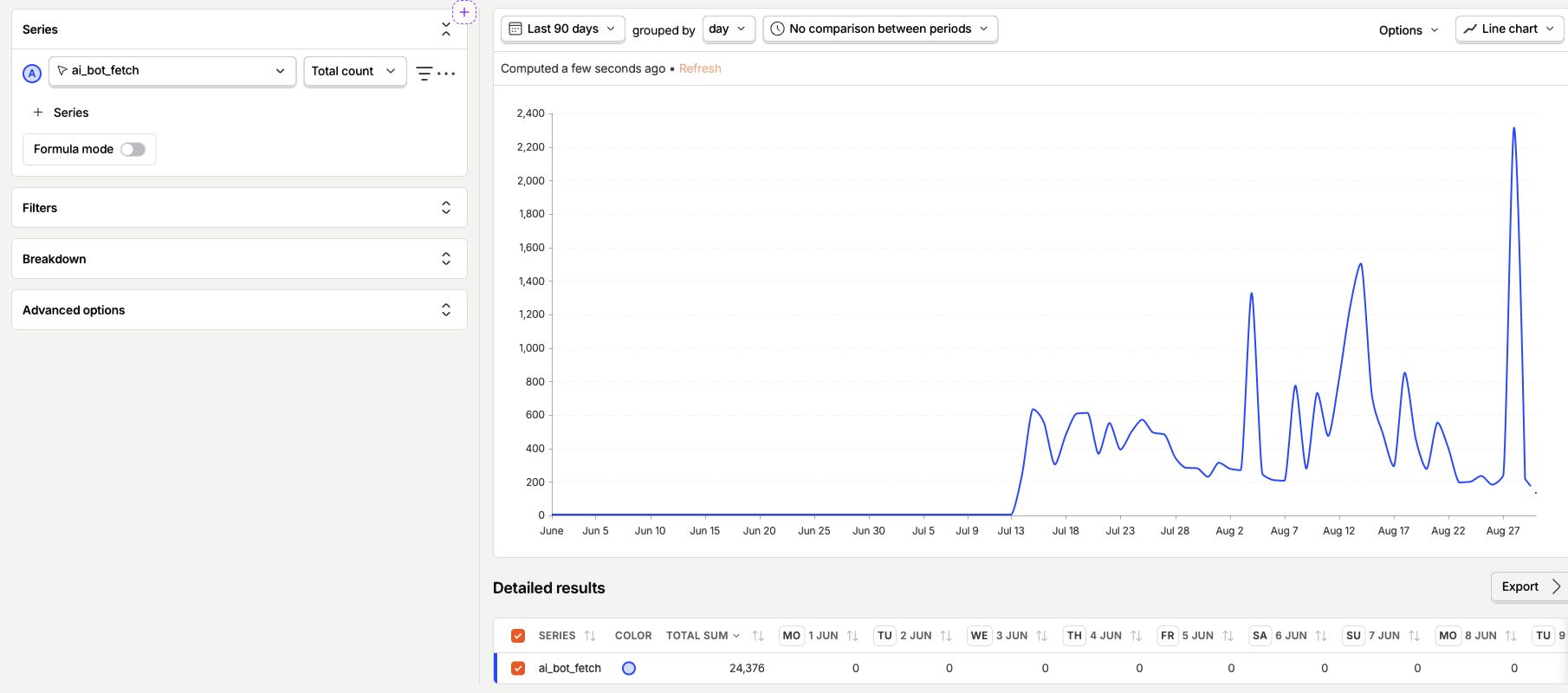
PostHog counted 24,376 ai_bot_fetch events over the last 90 days. The stream includes ChatGPT-User, OAI-SearchBot, ClaudeBot, PerplexityBot and Bytespider. Those are machine fetches, not 24,376 people, visits or bookings.
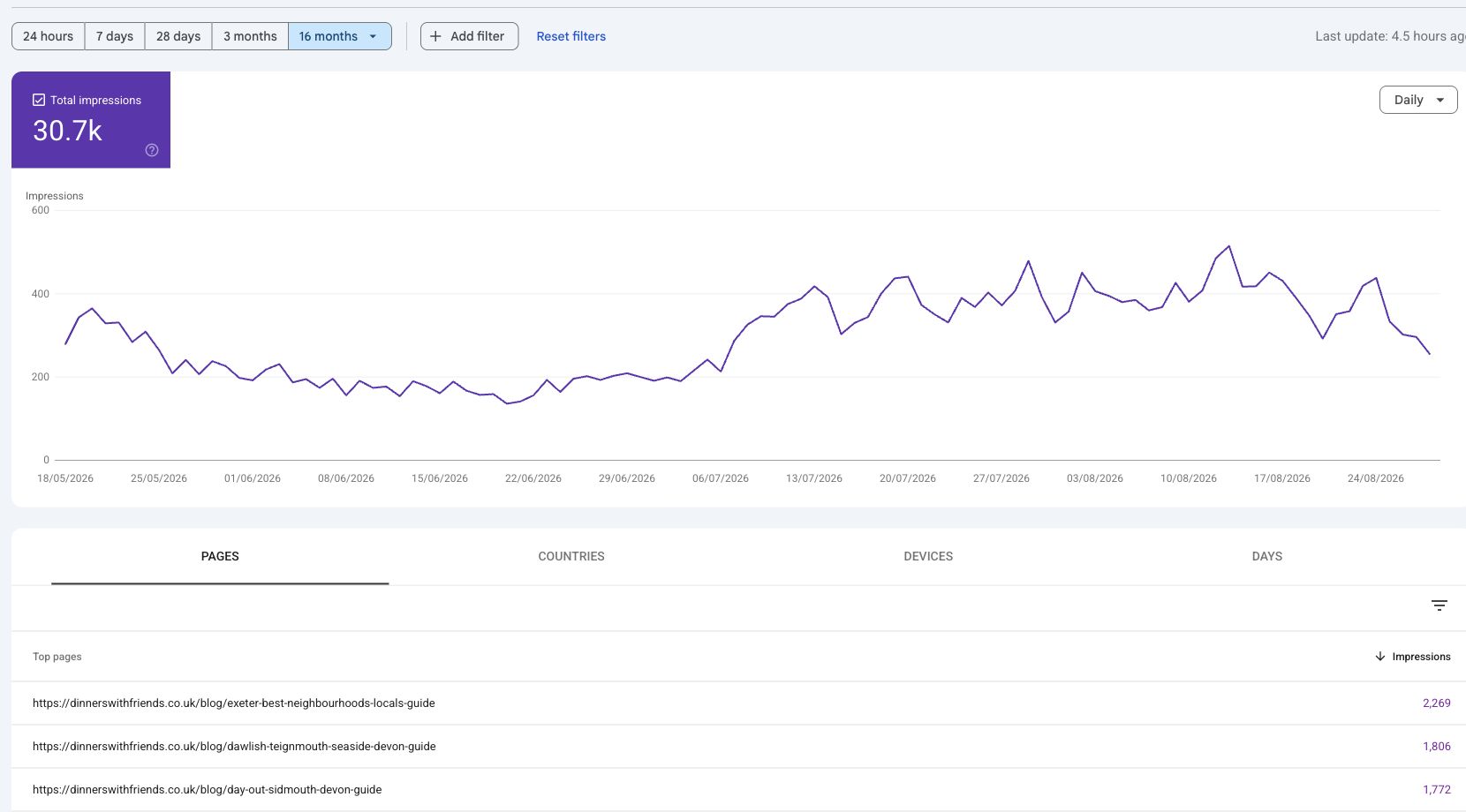
Google Search Console's beta Generative AI report showed 30.7K impressions in the available data. The leading pages were editorial: guides to Exeter neighbourhoods, Dawlish and Teignmouth, a day out in Sidmouth, beaches near Exeter and the psychology of sharing food. Google exposes impressions here, not clicks or citations.
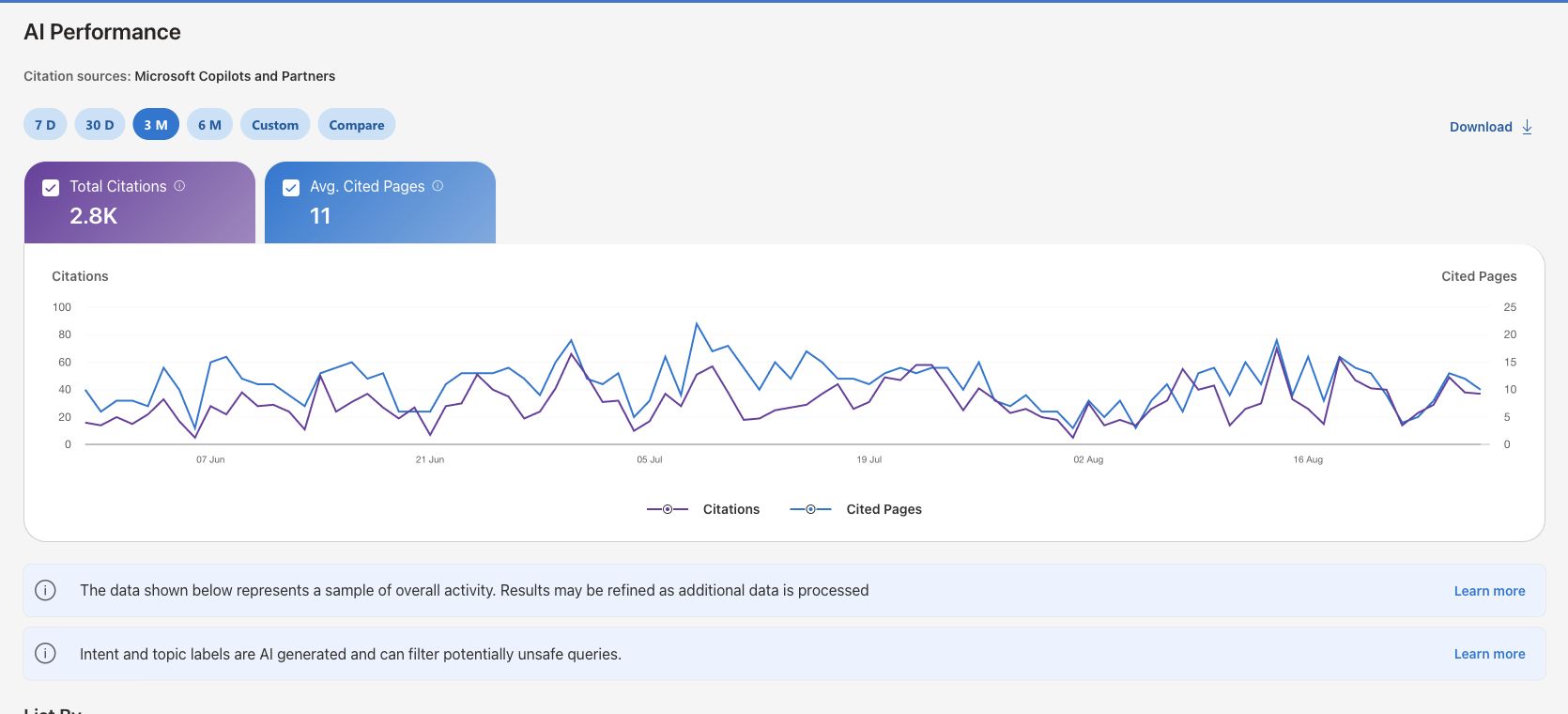
Bing Webmaster Tools reported 2.8K citations between 30 May and 29 August 2026, with an average 11 unique Dinners With Friends pages cited per day. Microsoft describes this report as aggregated data from Copilot, Bing AI answers and selected partners, and says its grounding queries are sampled. The homepage led, but local, friendship and food guides were being cited too.
What changed
I did not start by designing a large platform. I put the idea in front of people, took the first payments, watched what broke as the dinners filled and built the next piece from that evidence.
By September 2026, Dinners With Friends was nearly sold out for the rest of the year. Behind those full tables is a product I can keep changing: owned payments, bookings and customer data; an app for guests and hosts; infrastructure I control; and search and AI-discovery reporting that distinguishes attention from an actual customer.
WithSeismicThe analytics behind the workHow I connect customer behaviour, marketing and revenue across a product.